
What We Do
Accelerating Canada’s Cleantech Future
The Canada Cleantech Alliance (CCTA) works to strengthen Canada’s cleantech ecosystem by connecting industry, governments, investors and ecosystem partners around the opportunities that matter most.
Our work goes beyond advocacy. We develop practical policy recommendations, conduct research and analysis, convene leaders from across the ecosystem, support international market development, and share insights that help companies, decision-makers and partners navigate a rapidly evolving clean economy.
Whether we are engaging with governments, leading international missions, publishing thought leadership or bringing together Canada’s cleantech community, our goal remains the same: helping Canadian cleantech companies commercialize, scale and compete globally.
Our Work Includes
🍁 Policy & Advocacy
Working with governments at all levels to develop practical policies and programs that strengthen Canada’s cleantech ecosystem.
📊 Research & Insights
Publishing analysis, reports and thought leadership on commercialization, investment, competitiveness, exports, innovation and emerging opportunities.
🌎 International Growth
Supporting Canadian companies as they enter global markets through trade missions, strategic partnerships and export initiatives.
🤝 Convening the Ecosystem
Bringing together companies, investors, governments, researchers and ecosystem organizations to identify challenges and develop solutions.
🚀 Commercialization & Growth
Helping improve the conditions that allow Canadian cleantech companies to move from innovation to commercialization, scale-up and international success.

Insights & Analysis
Canada’s cleantech sector is evolving rapidly. Through our Insights, CCTA shares practical analysis, policy perspectives and real-world lessons drawn from across the ecosystem.
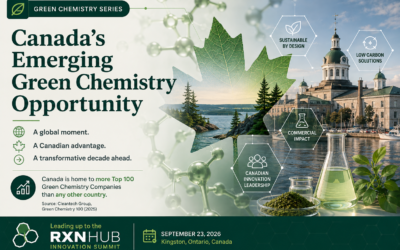
Green Chemistry: Canada’s Hidden Competitive Advantage
Canada is emerging as a global leader in green chemistry, with innovative companies developing cleaner materials, processes and products. As global demand grows, the opportunity is not only environmental—it is increasingly an economic and competitive one.

What Happens After Success?
Commercialization doesn’t end when a company succeeds. In many ways, that’s when the real opportunity begins. The world’s strongest innovation ecosystems don’t just create successful companies—they recycle the human, financial and social capital those companies generate to help build the next generation of innovators. As this series concludes, I explore why that may be Canada’s greatest untapped competitive advantage.
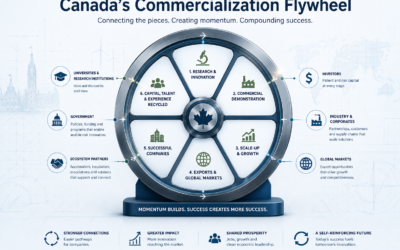
Canada’s Next Competitive Advantage: Building a Commercialization Flywheel
Canada has made significant progress building the foundations of a strong cleantech innovation ecosystem. The next opportunity is not simply to create more programs, but to better connect the many strengths we already have into an integrated commercialization system. By viewing commercialization as a continuous flywheel—where capital, talent, knowledge and experience are continually recycled into the next generation of companies—we can strengthen Canada’s long-term competitiveness and develop new ways to measure the success of our innovation ecosystem.
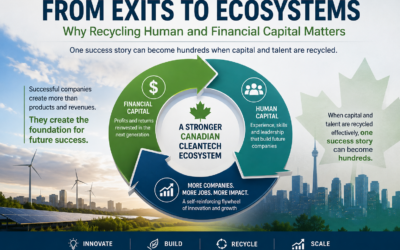
From Exists to Ecosystems
What happens after a Canadian cleantech company succeeds?
Much of the discussion surrounding Canada’s innovation ecosystem focuses on ownership, acquisitions, and retaining Canadian champions. These are important conversations—but they are not the only ones.
Successful companies create more than products, revenues, and jobs. They also create experienced entrepreneurs, skilled executives, knowledgeable employees, and financial returns that can be reinvested into the next generation of innovators.
The world’s strongest innovation ecosystems don’t simply create successful companies—they recycle human and financial capital to build stronger ecosystems over time.
In our latest blog, we explore why Canada’s long-term competitiveness depends not only on creating successful cleantech companies, but on ensuring that the capital, talent, and experience they generate continue to work for Canada.
We hope this article contributes to an important discussion about how Canada can build a stronger, more resilient, and globally competitive cleantech ecosystem.
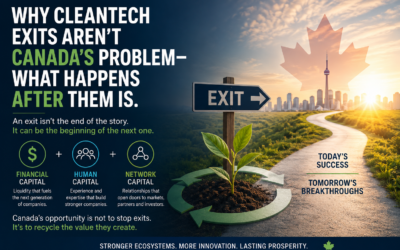
Why Cleantech Exits Aren’t Canada’s Problem—What Happens After Them Is
What if cleantech exits aren’t Canada’s problem?
After 15 years working in the sector, I’ve come to believe that acquisitions are often treated as the end of the story when they should be viewed as the beginning of the next chapter. Successful exits create financial capital, experienced founders, and global networks. The challenge is making sure those assets stay in motion within Canada’s cleantech ecosystem.
That’s the premise behind the first article in a new series exploring how Canada can build a self-reinforcing cleantech economy.
Cleantech is Advanced Manufacturing The Finale
Cleantech is no longer a niche environmental sector operating at the margins of Canada’s economy.
Increasingly, it is becoming part of the foundation of the modern advanced economy.
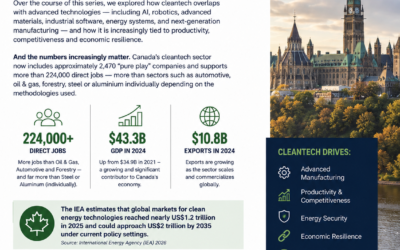
Over the course of this series, we explored how cleantech overlaps with advanced technologies including AI, robotics, advanced materials, industrial software, energy systems, and next-generation manufacturing.
And the numbers increasingly matter.
Canada’s cleantech sector now includes approximately 2,470 “pure play” companies and supports more than 224,000 direct jobs — more than sectors such as automotive, oil & gas, forestry, steel or aluminium individually depending on the methodologies used. The sector also generated approximately $43.3 billion in GDP in 2024 and exports continue to grow.
Before anyone comes after the numbers: yes, sector comparisons are imperfect. Definitions, methodologies, and the treatment of indirect jobs vary widely across industries. But even allowing for that, the broader conclusion remains hard to ignore.
Cleantech has quietly become a major contributor to Canada’s industrial economy. The countries that succeed in the coming decades will not simply invent technologies.
They will build the ecosystems capable of manufacturing, financing, deploying, and exporting them at scale. And increasingly, many of those technologies are cleantech technologies. The next industrial economy will not be built separately from cleantech. It will increasingly be built through it.